BADHAM'S
HARALD VIKE
Exhibition
from
Saturday 9th April until Sunday 17th April
2005
Gallery Hours
Monday – Friday 10am until 5pm
Saturday And Sunday 2pm until 5pm
For over three decades, Harald Vike’s artwork has been
consistently before the Australian public. There have been retrospectives
at the Art Gallery of WA, exhibitions by dealers and commercial galleries.
Numerous works have been offered and sold at auction and there have been
large donations of the artist’s paintings and drawings, to collecting
institutions across Australia. He is one of the few artists considered to
be Western Australian, whose reputation is genuinely national.
Collectors, curators, aficionados and the public in general, all seem to
have an opinion about Harald Vike’s pictures. However, few know of
the esteem the important artist, teacher and writer Herbert Badham held for
Vike. In 1949, Badham wrote in his book A Study of Australian Art,(1) …….“He
(Vike) arrived in Melbourne seven or eight years ago, and his eyes opened
to all the city had to offer………… “ but his
impetuous nature, excited by all he saw and heard about him, would not permit
him to pledge himself to any one form of expression.”
Vike maintained his enthusiasm for most things new all his creative life.
He worked in various styles including, impressionism; post-impressionism;
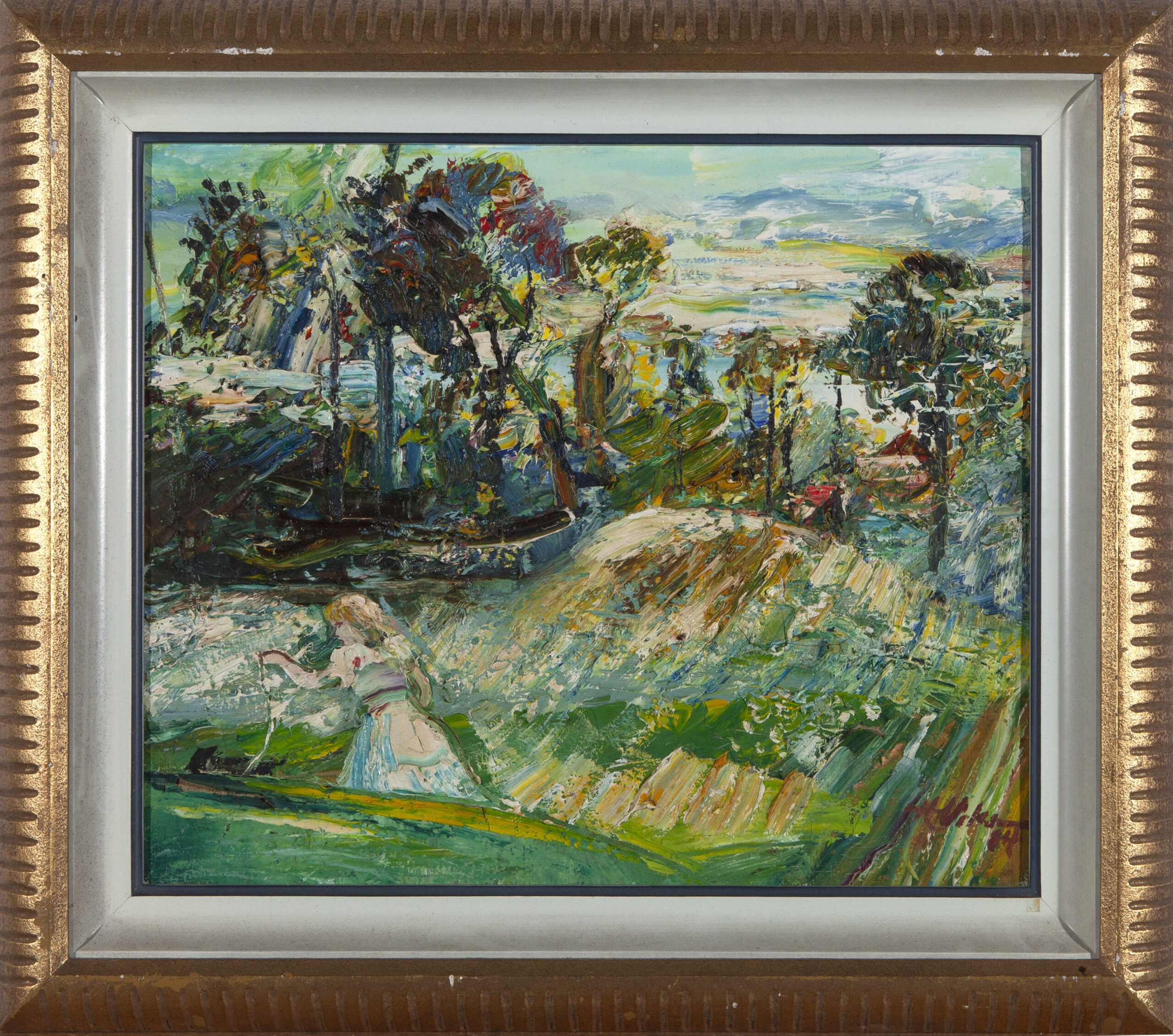
modernism; abstraction and realism. In this exhibition and using his variety
of styles, his subject matters include the aboriginal dreamtime; Greek legends;
the Australian landscape and its cities; people at work and people at play;
nature from desert to rainforest; children concentrating on the job at hand;
blossom falling from trees in a manicured parkland and even a protestor battling
the elements at the Frankland River blockade. Vike has used his abilities
and powers of observation, to record all about him in the manner he saw fitting.
His technique was much more diverse than simply being the follower of post-impressionism
his audience became familiar with during the 70’s and 80’s.
It wasn’t until after his death in 1987 that Vike’s multiples
of style became wider known and it coincided with all the works forming his
estate coming into the market place as a single package. That event caused
an immediate commotion within sections of the art market. Agents contacted
interstate dealers and local operators began to consult to various parties
interested in acquiring the collection. The art world was abuzz with rumour
about the progress on the disposal of the Harald Vike estate. Much of the
rumour was fact, but most of it was fiction.
Seven figure prices were mentioned and quantities of works in the tens of
thousands were bandied about. The collection quality was a hot topic. Once
again everyone had an opinion, this time it was about the wisdom of buying
the Harald Vike estate. Some thought it was a good opportunity - others thought
it wasn’t.
The art market was in boom mode when the collection was finally sold to
a company controlled by a group of local businessmen. At that time, record
prices were being achieved at every art auction, commercial galleries were
having sell-out exhibitions, amateur and professional painters alike couldn’t
finish work quickly enough, demand was strong and quality was compromised.
Art consultants began popping up like mushrooms in a country paddock and
once again everyone had an opinion. This time it was about the excitement
surrounding the art market. The boom was in full swing and it seemed as though
it would go on forever.
The new owners of the Vike estate engaged experienced consultants and commenced
to market the artist and his art. It started with a general exhibition, followed
by a retrospective showing at the Art Gallery of WA. The retrospective had
attached to it a well written and researched, extensively illustrated, notch
bound glossy catalogue. Further exhibitions were organised locally and interstate
and for a time, the business of Harald Vike seemed more important than the
art of Harald Vike, and many in the art world resented it.
The artists name was on everyone’s lips and one of the commercial
galleries operating in Perth at the time had Vike’s works on their
walls priced as high as $50,000.
Unfortunately for the local businessmen all of the promotional activity
surrounding the estate coincided with the start of, “the recession
Australia had to have.” (2) The art market felt the recession harder
than most areas of the economy and the effect was immediate. Auction turnover
in 1990 fell to just 20% of 1989 levels (3) ; contemporary artists expecting
sell out shows were struggling to survive, galleries closed their doors forever
and the numerous art consultants went into hibernation, awaiting the next
boom. Along with them all, Vikes artwork sales and prices also became a victim
of the slow down.
A number of years into the recession, the owners of the estate had to take
a commercial decision. Sales were down, but holding costs were constant.
They chose to dispose of the collection in a variety of different ways. The
dispersal was handled discreetly and with aplomb, but within art circles
rumours were spread and stories told. And caught up in it all, was the reputation
of Harald Vike and his artwork.
Posthumously he was linked to the investor purchase and the machinations
surrounding it. We can only speculate where Vike’s greatest disappointment
would lie, and being a former member of the Workers Art Guild (4) and a reluctant
seller of his pictures during his lifetime, he would have probably found
the developments most unpalatable.
The business of Harald Vike finished almost a decade ago. Now the art of
Harald Vike is the focus again. His pictures and drawings have continued
to be offered across the Australian market through auction and exhibition.
Watercolours of Perth have sold for $11,000 at auction (a hangover from the
days when he was depicted as merely a recorder of topography) and his landscapes
and self-portraits have found ready homes with collectors revisiting his
work. His artistic prowess is to the fore again and the disposal of his estate
in the late 80’s and the theatre accompanying the event, is now being
looked upon as just an interesting sideshow.
The varying styles that Vike used have been specifically chosen for this
exhibition. They exhibit his versatility as an artist and further support
Badham’s view of the artist’s prowess – hence we have titled
the exhibition Badham’s Harald Vike. We have included the works that
have a heavy impasto in addition to those that have focused on tone. Frieze
like compositions are also on show as are his watercolours and drawings.
The exhibition has not been themed to topography; portraits; landscapes or
footballers et al. It has been selected to show-off Vike as an artist first
and foremost, and one whom loved life and all that went with it.
(1) Herbert Badham – A Study of Australian Art Currawong Publishing
1949
(2) One of Treasure Paul Keating’s descriptions of the recession of
1990
(3) Source Australian Art Auction Records compiled by E Craig
(4) The Workers Art Guild operated in Perth in the 1930’s. Artist exhibitors
included Vike, John Lunghi, John Oldham and Herbert McClintock.
Notes
Harald Hansen Gallis Vike
Born Norway 1906; Arrived Australia 1929; Died Australia 1987
Studies – Perth under George Pitt Morison, largely self- taught.
Represented - National Gallery Victoria; Art Gallery of Western Australia;
National Gallery of Australia