ELWYN
LYNN
WORKS
1957-1990
Exhibition
from
Friday 16th September until Friday 23rd September
2005
Gallery Hours
Monday – Friday 10am until 5pm
Saturday And Sunday 2pm until 5pm
To those artists who don’t tickle the belly of the Australian
public in search of popularity, success and importance in their field doesn’t
always equate to financial safety.
Most of the work produced by the major non - figurative painters of the
50’s and 60’s was vilified in its time and continues to be overlooked
by today’s art buying public. Many of those late career artists are
still searching for an appreciation of their work that extends beyond that
of the art institutions.
In the 1950’s abstract or non - conventional painting was an easy
target for derision in Australia, and the public was encouraged to resist
the international trends that were attracting the younger generations of
painters.
As a response to abstraction, the Antipodean Manifesto was composed and
the figurative was deified as opposed to the abstract that was treated with
misgiving.
The signatories to the Antipodean Manifesto became celebrated, as the art
buying public rallied to the cause. They included Arthur and David Boyd,
John Brack, Charles Blackman, Robert Dickerson, Clifton Pugh and John Perceval.
It seemed that Australia should be a bastion of all that was perceived as
wholesome in art and the new was to be treated as an aberration.
Abstraction was xenophobic to those that should have known better and in
hindsight it could be claimed that the manifesto was a simply brilliant 1950’s
marketing tool that is still in effect today. Lynn observed that it was the
only conservative manifesto in history and it was an aggravation to he, John
Coburn and others interested in the international trends.
From the 50’s through to the late 80’s, support for the abstractionist
rarely extended beyond the institutions, so most of the bread winners influenced
by the international art trend had to seek alternate careers to provide for
themselves and family.
Elwyn Lynn was from that generation and from that group of artists. In his
early career his work was figurative and relatively conventional with a modernistic
palette, but from the late 1950’s and onward, his direction altered
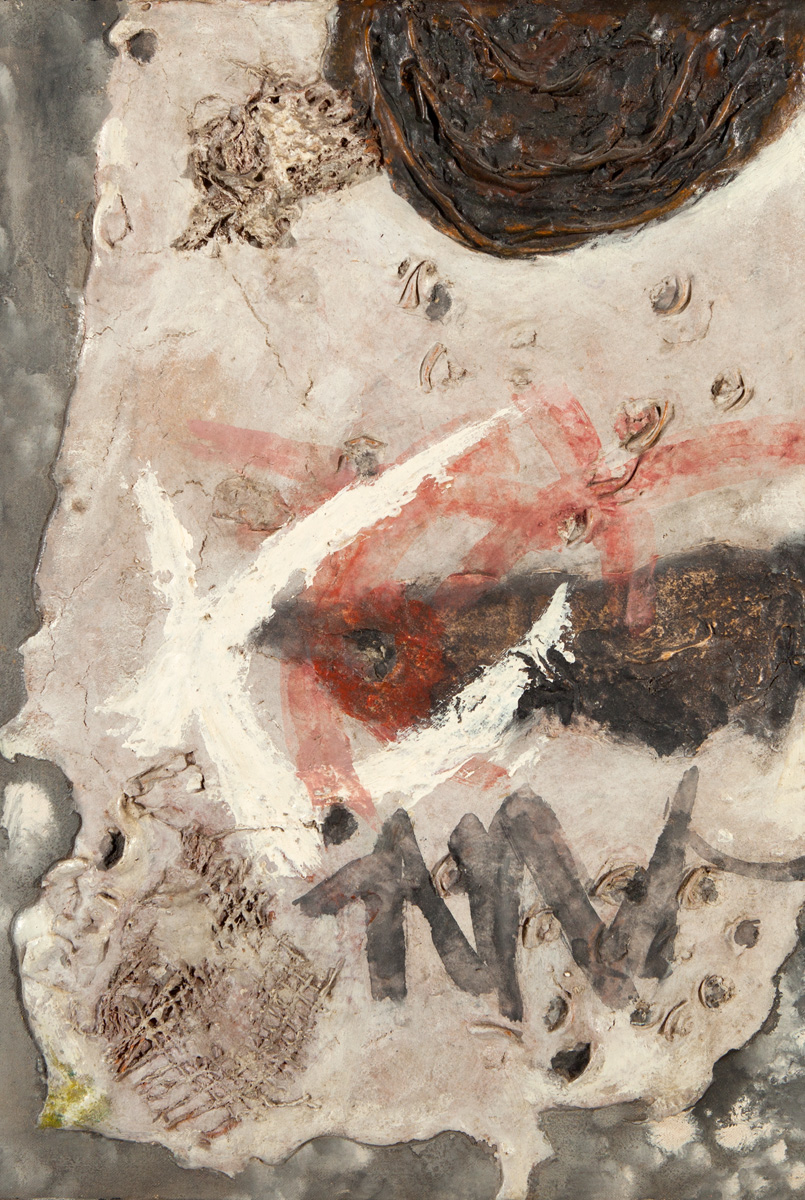
and he was considered to be Australia’s foremost exponent of texture
painting.
His images became abstracted and his use of colour restrained. He was one
of those artists that was nudging Australia into internationalism and outside
of the institutions, Lynn’s work was not popular and received scant
understanding.
Writer, teacher, administrator and critic are just a few of the hats that
he wore during his long and outstanding career. When he wasn’t busy
in those pursuits he was constantly satisfying his appetite for literature,
devouring works by the world’s great writers, as well as the contents
of any art publications that satisfied his need. Lynn was credited with an
encyclopaedic knowledge of 20th century art.
He served as the chair of the Visual Arts Board of the Australia Council
and at different times performed the task of art critic for the Bulletin,
the Weekend Australian and the Sunday Mirror. He was curator of the Power
Gallery of Contemporary Art for fourteen years and edited some of Australia’s
more influential arts magazines including Art and Australia and Quadrant.
For his services to the visual arts he received many accolades and was made
a member of the Order of Australia in 1975. He was also awarded an Honorary
Doctorate of Letters from the University of Sydney in 1989 and an Emeritus
award from the Australia Council in 1994.
As an artist the Art Gallery of New South Wales holding a retrospective
exhibition of his work in 1991 acknowledged his importance. He was awarded
the Wynne Prize for Landscape painting in 1988, The Blake Prize in 1957,
The Robin Hood Prize in 1961, The Trustees Watercolour Prize of the AGNSW
in 1980 and 1983 and the University of NSW Purchase Prize in 1987. His biographical
details are included in the standard reference books related to Australian
art, and his work is included in the holdings of every major collecting institution
throughout Australia.
Elwyn Lynn was one of the few people that was able to combine a successful
career as an arts administrator without losing status as an important artist.
And while it was the administrative career that provided for the family,
it is through his art that his influence continues as he maintains a dialogue
with this generation and those that will follow.
He has left for us many images, some with titles that puzzle and give us
cause to engage the intellect and others that do not challenge at all. And
even if we are unable to solve the riddle of the name, we can always feel
comfortable in the presence of a solid inspirational work that contains a
spirit, which only a major artist can invoke.
We at GFL are pleased to present this exhibition of Elwyn Lynn’s work.
It is history on display and the first time such a comprehensive collection
has been seen in Western Australia since the Skinner Gallery show of 1971.
Source material: McCulloch’s Encyclopaedia of Australian
Art Edition 1, Elwyn Lynn Retrospective Catalogue, Peter Pinson; Australian
Painting
1788 – 1970, Bernard Smith; Elwyn Lynn Metaphor + Texture, Peter Pinson.
Studies: No formal training in art; degree in Fine Art Sydney University;
Diploma of Education.
Awards: Blake Prize 1957; Mosman Prize 1957; Marrickville Prize 1961; Campbelltown
Prize 1962; Muswell Brook Prize 1963; Wollongong Prize 1963 & 64; Royal
Art Society Modern Prize 1965; Robin Hood Prize 1966; Membership of Order
of Australia 1975;Trustees Watercolour Prize AGNSW 1980 & 83; University
New South Wales Purchase Prize 1987; Wynne Prize 1988; Honorary Doctor of
Letters University of Sydney 1989; Emeritus Award Australia Council 1994.
Represented: Art Gallery of NSW; Art Gallery of SA; Art Gallery of WA; Auckland
City Art Gallery; National Gallery of Australia; National Gallery of Malaysia;
National Gallery of Victoria; Parliament House Art Collection Canberra; Queen
Victoria Museum and Art Gallery Launceston; Tasmanian Museum And Art Gallery;
Queensland Art Gallery, and numerous other university, regional and private
collections throughout Australia.
Exhibitions: Over 200 group and solo exhibitions in Australia, England and
Germany including; Museum of Modern Art Melbourne 1958, 1960 & 1963;
Mid Career Retrospective Ivan Dougherty Gallery Sydney 1977; Retrospective
Exhibition Art Gallery of NSW 1991; Opening of the Elwyn Lynn Conference
Centre, University of NSW 1995; Elwyn Lynn Works 1969 –1996 Nolan Gallery
Canberra; Elwyn Lynn Works on Paper Charles Sturt University NSW 2004.
Author: Contemporary Drawing, Longman Melbourne 1962; Sidney Nolan Myth & Imagery,
MacMillan London 1967, The Australian Landscape and its Artists, Bay Books
Sydney 1977; Sidney Nolan – Australia, Bay Books, Sydney 1979: Judy
Cassab, Places, Faces and Fantasies, MacMillan Melbourne 1984;
The Art of Robert Juniper, Craftsman House Sydney 1986